
One of the goals of this project was to create a collection of medieval representations (both images and textual selections) depicting guide dogs. The project was focused on evidence from medieval manuscripts, although other sorts of evidence (e.g., evidence from statues) are also included in the project’s collection.
The project was focused on guide dogs rather than other sorts of support animals; this is not to suggest that guide dogs are more important than other sorts of animals, but simply to ensure the project had a clear focus (my future work will consider other sorts of support animals).
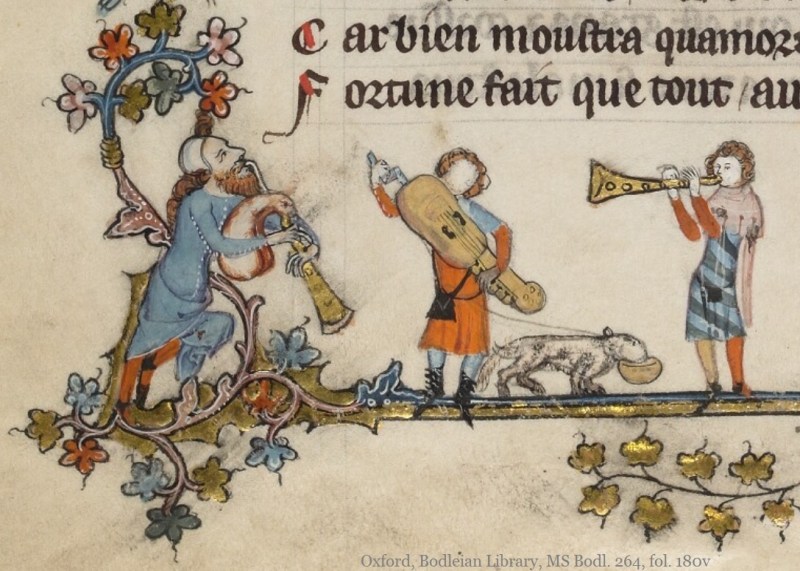
I go into some detail about the process used to collect medieval representations of guide dogs in my forthcoming book, Textual and Artistic Representations of Guide Dogs in Northwestern Europe, 1100 to 1500. In order to avoid repeating what I write there, I give here a brief overview of the process. The process began by identifying relevant databases and catalogues for the areas under investigation: France, The Netherlands, the UK, and Belgium. I searched these databases and catalogues for representations of guide dogs, using the criteria for identification outlined below. I also searched through manuscripts that I suspected, based on various clues, might have contained representations of guide dogs. As I note in my book, while it might be assumed that representations of guide dogs would be limited to religious manuscript contexts, such representations appear in a remarkably wide range of texts and manuscript contexts.
Identifying a guide dog in a medieval work must be approached with caution. We cannot assume that characteristics and features associated with modern guide dogs (e.g., certain types) would be the same for medieval guide dogs. Moreover, we must remember that the artistic works and texts under consideration here are not straightforward representations of daily life in the medieval period, and we must consider that iconographic and textual conventions surrounding these representations may or may not have had any correspondence to daily life during the medieval period.
In order to be systematic in my approach to the material, I applied a set of consistent criteria to the identification of guide dogs for this project (I also collected representations that did not meet these criteria, and I have featured some these representations in the online exhibit for the project, but they are not included in the primary collection of the project). These criteria, explained in more detail in my book, pertain to both the dog and the human figure or figures in each representation. The dog must be depicted as providing support in some way (but as I point out in the book, providing this kind of support represents only part of a modern guide dog’s day, and we can assume this was true for medieval guide dogs as well). The human who is with the guide dog must be depicted as blind or as having a visual impairment in some way; determining whether a representation meets these criteria is far from straightforward.
Using these criteria, I was able to gather a collection of representations of medieval dogs which formed the basis of the analysis presented in my book and of the online exhibit/page, which is aimed at making some of the findings of my work more accessible.
 KRISTA A. MILNE