
While this project was aimed at gathering representations of guide dogs from medieval manuscripts produced between 1100 and 1500, my work on this project led me to identify other examples of pre-modern guide dogs that appear outside of these contexts, and this blog post is aimed at highlighting a few of them.
As noted in this 2018 post, there is a long history of representing guide dogs in art and in other media. Within a European context, one of the earliest depictions of a guide dog may be a wall painting that was in Pompeii during the eruption of Mount Vesuvius in 79 CE and that remains to this day.
From the twelfth century we find an artistic representation of Tobias (who is blind in the episode depicted) and his dog in a Bible (Tuscany, Bibl. Laurenziana Edili 125 and 126, vol. II, fol. 73r). The image, produced in Italy, falls outside of the geographical scope of this project and it cannot be considered among representations of guide dogs in any straightforward way, but it is worth noting that there was a tradition of depicting Tobias’ dog as a guide dog during the medieval period (I discuss this further in my book on medieval guide dogs).
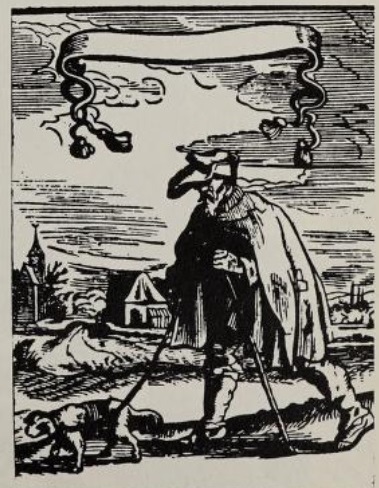
Another artwork from outside the project’s focal area is a 1465 woodcut mentioned in Nelson Coon’s A Brief History of Dog Guides For The Blind (1959; p. 15):
As with the representations in the project collection, the man’s clothes are tattered, suggesting financial difficulties.

Also relevant here is an engraving by Pieter van der Heyden (Creative Commons licensed) dated to the middle of the sixteenth century. The scene is intended to depict the expression about the blind leading the blind.
Since images such as this one fall outside of the temporal scope of the project collection, they are not included in the online exhibit for the project, but since they are important for the history of guide dogs they are discussed among early modern examples in my forthcoming book.
 KRISTA A. MILNE
